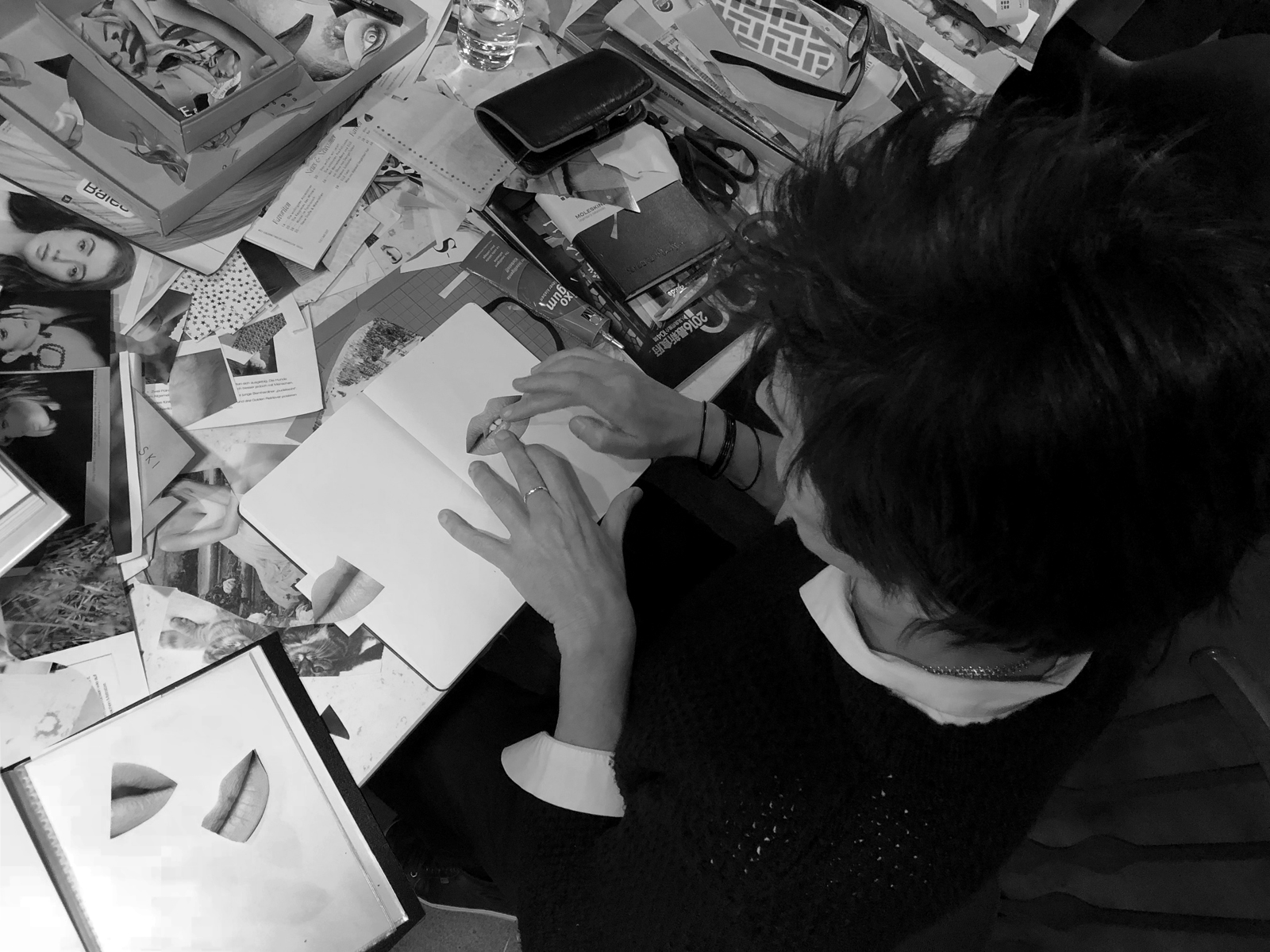
Isabel Reitemeyer
1966 born in Nordhorn, Germany. Since 2002 living and working in Berlin. Isabel Reitemeyer studied visual communication at the University of Applied Sciences in Münster. Before turning her focus on collage, she worked as a printer, freelance graphic designer, and artistic assistant on renowned German and international film productions, including Mogadischu, Das wilde Leben, and Der Vorleser. Reitemeyer's collages have been published on numerous record and magazine covers and shown in exhibitions worldwide—including at renowned institutions such as the Bröhan Museum Berlin, the Museum Böttcherstraße Bremen, and the Frauenmuseum Wiesbaden.
Artistic Statement
In 2002, I discovered collage as a medium for myself. I work with traditional media and prefer images from the period between 1960 and 1990, when books and magazines were not yet produced digitally. I usually work intuitively and like things to be neat and calm—at least on paper. I try to express a feeling using as little material as possible, but I also want to find out how much I can leave out to create a meaningful image.
Artistically, I’m inspired by what deviates from the norm: the different, the unsettling, and the imperfect.
My artistic work is, on the one hand, an exploration of what is happening around me right now, but at the same time, it is also a reaction to global events.
What others say about me
Isabel Reitemeyer's collages are disconcerting and yet strangely familiar. Attracted by an image, usually of a person or animal, Reitemeyer cuts away essential elements that determine our interpretation. She covers eyes so that they no longer direct our gaze, merges dissimilar images, or isolates fragments. She does not embellish images—she reduces them. In search of an essence, she creates entirely new beings: animals transform into fluffy balls or disturbing chimeras, models are swallowed up by their haircuts. Thin slivers of paper give rise to entire worlds. By refusing to conform to the norm, her extraordinary images challenge our viewing habits. Leonor Faber-Jonker, 2022
Leonor Faber-Jonker, 2022